- 5.0powered by
- (647) 877 5977
- contactus@fromdarktolight.ca
Why Pet Odour Keeps Coming Back in Carpets – And How to Actually Fix It
Why Toronto Homes Need More Frequent Carpet Cleaning Than You Think
May 19, 2026
What’s Actually Inside Your Mattress – And Why Cleaning It Matters
July 16, 2026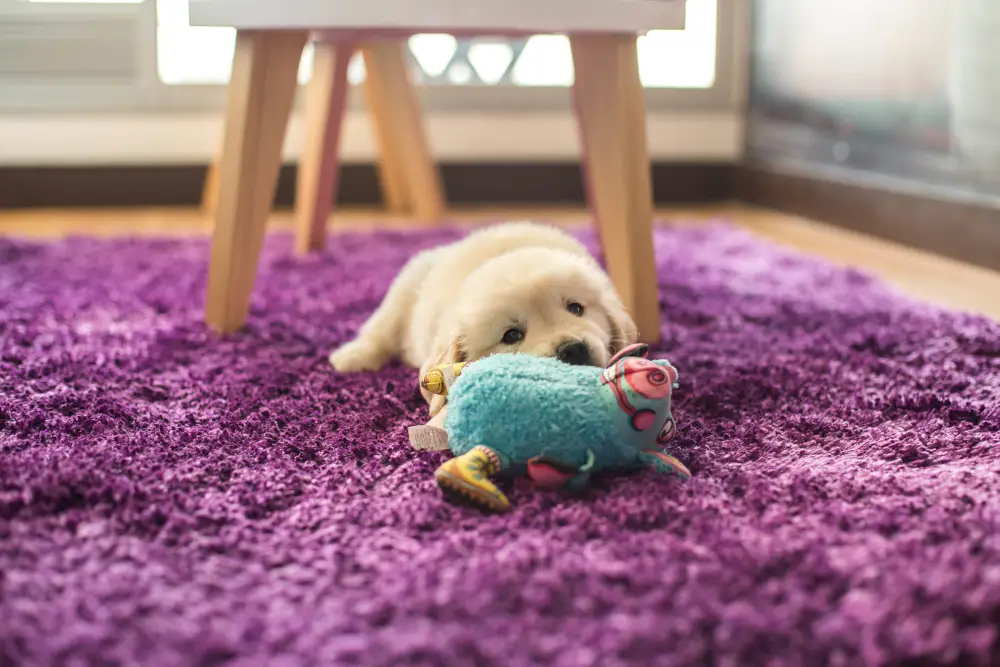
You cleaned it. You used the spray from the pet store. Maybe you scrubbed it, blotted it, and covered it with baking soda. The smell seemed to go away – but then it came back, sometimes stronger than before. If you’re a pet owner in Toronto or the GTA dealing with this, you’re not doing anything wrong. The problem is that most pet odour products aren’t designed to actually solve the problem. Here’s what’s really happening.
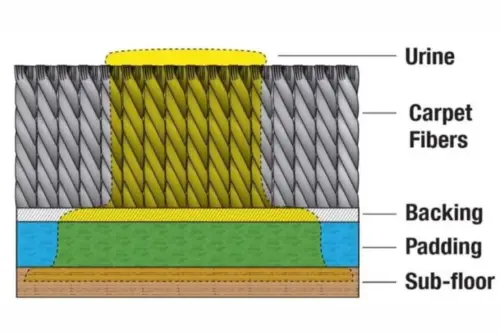
Cross section of the carpeted floor saturated with urine.
The Science Behind Why It Returns
Pet urine contains several compounds, but the one responsible for persistent odour is uric acid. When urine dries, the water evaporates but the uric acid crystallizes and bonds to carpet fibres, upholstery fabric, and even subfloor materials.
These crystals are largely insoluble in water. Standard cleaning products – including most “pet odour eliminators” sold at retail- clean around them or dilute the surface, but they don’t break down the crystals themselves.
Here’s the critical part: uric acid crystals are activated by moisture. When humidity rises – in summer, after rain, or when you clean the area with water – the crystals reactivate and release odour compounds again. This is why the smell seems to disappear after cleaning and return later, often seeming worse than before.
Why Consumer Products Don’t Work
Most retail pet odour sprays work in one of two ways: they use surfactants to clean the surface, or they use fragrance to mask the smell. Neither approach touches the uric acid crystals embedded in the fibres.
Some products claim to use enzymes – and enzyme-based cleaners are the right category – but consumer enzyme products typically don’t have the concentration or dwell time needed to fully break down crystals in carpet padding or upholstery fill. They work on fresh surface accidents and light contamination, but not on established, repeated-accident areas.
Professional Pet Odour Removal: What Actually Works
Professional enzyme decontamination uses a different class of product – high-concentration enzyme solutions that are applied in sufficient quantity and allowed sufficient dwell time to fully digest the uric acid crystals, proteins, and bacteria in the contaminated material.
The process works like this:
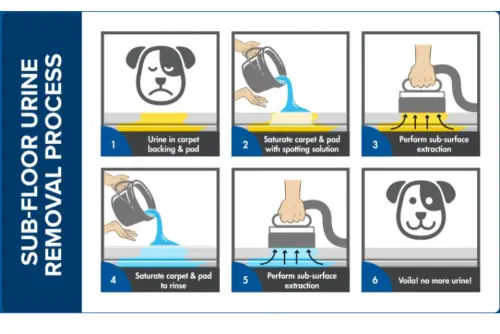
Pet urine removal process
UV Inspection First A black light reveals the full extent of contamination – including spots that are invisible in normal light. Pet urine spreads outward and downward from the point of contact, often covering a significantly larger area than the visible stain. Treating only the visible area leaves the surrounding contamination untreated.
Pre-Treatment Concentrated enzyme solution is applied to all contaminated areas and allowed to dwell, beginning the process of breaking down the uric acid crystals.
Deep Extraction Professional extraction equipment removes the physical contamination – dissolved crystals, bacteria, and residue – from deep within the fibres and padding.
Final Enzyme Application A second enzyme application treats any remaining contamination, ensuring complete elimination rather than partial treatment.
When done correctly, this process permanently eliminates the odour source. There’s nothing left to reactivate.
What About Heavily Contaminated Areas?
In cases where a pet has repeatedly used the same spot over a long period, contamination can saturate through the carpet, through the padding, and into the subfloor. In these cases, the carpet and padding may need to be replaced and the subfloor treated directly.
A professional cleaner with UV inspection equipment can assess the extent of contamination honestly and tell you upfront whether cleaning alone will solve the problem or whether replacement is needed in specific areas.
Pet Owners in GTA: We Can Help
At From Dark to Light, pet enzyme decontamination is one of our most requested services. We serve pet owners across Toronto, Mississauga, and Oakville – and we use UV inspection on every pet job to make sure we’re treating the full extent of contamination, not just the visible spots.
If you’ve tried everything and the smell keeps coming back, call us at (647) 877-5977. We’ll give you an honest assessment of what’s going on and what it will take to fix it permanently.